
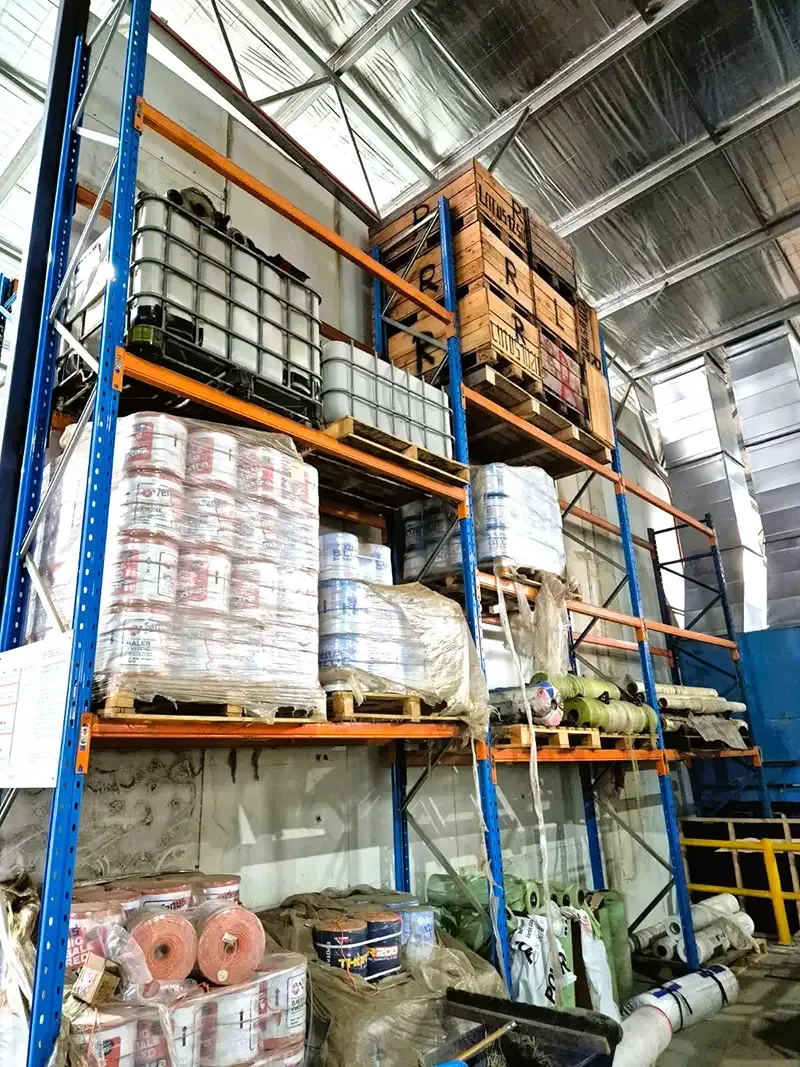
For around 30 years, Workspace Systems has fitted out sheds and warehouses across Gippsland and regional Victoria, from a single wall of racking in a small business shed to a complete parts warehouse.
It’s the only Gippsland supplier delivering pallet racking at scale, with stock on hand and a local team to design and install it.
If your shed floor is filling up, racking may be the answer. How much more can your space hold? That depends on what you store, your shed height and your forklift’s reach.
Simon Cox from Workspace Systems explains what he considers and how three local businesses gained more storage.
Real results from local businesses
Gippsland Truck Centre: 146 pallet spaces in a new parts warehouse.
When Gippsland Truck Centre moved its parts department into a new shed, the brief was to maximise storage from day one. With mostly standard pallet sizes already known from the old shed, Simon drafted a layout from the building plans. A site visit confirmed the internal dimensions, which can differ slightly from the plans. The fit-out delivered 146 pallet spaces, with the team very happy with the result.
RACV Solar: from 14 pallets to 42. RACV Solar’s local team of eight to ten receives truckloads of stock from a central warehouse. Following a site visit, Simon installed racking along two shed walls, increasing capacity from about 14 pallets to 42. Crews could stay in the field longer without waiting for stock, the business avoided leasing a second warehouse, and stock tracking became simpler.
[Business name to confirm]: six bays, months of stock on hand. This small home battery backup installer bought six bays of racking. “For them, it was a game changer,” Simon says. Capacity grew from three or four pallets to 30 to 40, allowing bulk orders at better prices and improved margins. Holding several months of stock also meant supplier shortages no longer delayed jobs.
For businesses carrying stock, the right racking does more than organise a shed. It improves workflow and purchasing efficiency.
What Simon checks before he quotes
- What you store. This determines the type of racking. “Anything that can go onto a pallet can be racked on a pallet rack,” Simon says. That includes boxed stock, equipment, solar panels and veggie bins. Long or bulky items, from around two to six or eight metres, suit cantilever racking, including timber, steel, extrusions, irrigation pipe, tubing, wire and hose reels. Workspace Systems supplies cantilever racking to builders and building yards across the region.
- Shed height and length. Height determines the number of racking levels, with pallet racking ranging from about 2.4 metres to more than 9 metres. Wall length determines how many bays will fit.
- Forklift reach. There’s no benefit installing racking to 7 metres if your forklift only reaches 4.5 metres.
- Aisle widths. Larger warehouses need enough room for forklifts to turn, so aisle space is factored into the layout from the start.
- 5. Load rating/capacity: Standard pallet racking generally carries around 2 tonne per level, with options to increase that up to 4.5 tonne or lighter duty options available for light pallet capacity or even hand load options closer to around 1 tonne per level.
With cantilever racking, Heavy-duty styles support around 1,000 kg per arm, accommodating packs of steel weighing six to eight tonnes. Lighter-duty cantilever support around 300 kg per arm and are more suited for lighter timber and extrusion or pipe storage.
How pallet racking is sized
Pallet racking is sized around the pallet. A standard pallet is roughly 1,200 mm wide, so a standard 2.6-metre bay holds two pallets with some clearance. The common 840 mm depth allows a pallet to sit on the beams and lock in place, while 1,200 mm deep racks suit deeper loads such as solar panels.
Where a full bay won’t fit, a half bay of about 1,370 mm holds one pallet. For a recent 12-metre shed wall quote, Simon fitted four and a half bays. Longer custom beams are also available. Cabinet makers storing 3.2- or 3.6-metre boards can use Workspace Systems’ 3.6- and 4.2-metre beams.
| Item | Common size |
| Standard pallet width | About 1,200 mm |
| Standard bay width | About 2.6 m, fits two pallets |
| Half bay | About 1,370 mm, fits one pallet |
| Pallet racking depth | 840 mm (1,200 mm for deeper pallets) |
| Pallet racking height | About 2.4 m to 9 m plus |
| Custom beam lengths | 3.6 m and 4.2 m (popular with cabinet makers) |
| Cantilever arm spacing | 900, 1,200 or 1,500 mm |
How cantilever racking is sized
Simon starts with the longest pack being stored. Timber and steel commonly come in six-metre lengths for easy truck transport. A typical setup has four bays with bracing at 1,200 mm centres, spanning 4.8 metres and allowing about 600 mm overhang at each end of a six-metre length. This is Workspace Systems’ most popular size.
Bracing is generally spaced at 900, 1,200 or 1,500 mm. Specialty timber suits 900 mm spacing to minimise sag between arms and bring arm levels closer together. Rigid items such as downpipes can use 1,500 mm spacing. Closer bracing also adds another arm level, increasing the rack’s total load capacity.
Do you need a site visit?
Often, no. Customers can send a photo and dimensions of their shed wall, allowing Simon to quote without a visit. This is more common than an on-site inspection and speeds up the process.
For larger warehouses, a site visit helps Simon confirm bay spacing and forklift turning room before preparing a 3D visual layout. “There’s nothing worse than getting to site and realising something hasn’t been measured correctly,” he says.
What to have ready before you call
Simon can guide you, but having the measurements ready speeds up quoting. “If they come to us with those dimensions already, it makes it a lot easier for us to get a quote in front of them faster,” he says.
- What you want to store, and roughly how much
- Pallet sizes, or the length of your longest items
- Shed height, plus the length of the wall or floor area to rack
- A photo of the space
- Your forklift’s maximum reach
- The weight per pallet or per pack, and the capacity you need
- Any preference on new or secondhand, colour, style or brand
How long does it take?
Workspace Systems keeps a wide range of racking in stock, with supply usually taking one to two weeks. Installation is scheduled with you and typically adds about a week, bringing most jobs to two to three weeks from supply to installation. Non-standard beam sizes are subject to availability.
Want to see how much more your shed can hold? Send your measurements and a photo to Workspace Systems for a racking quote.